
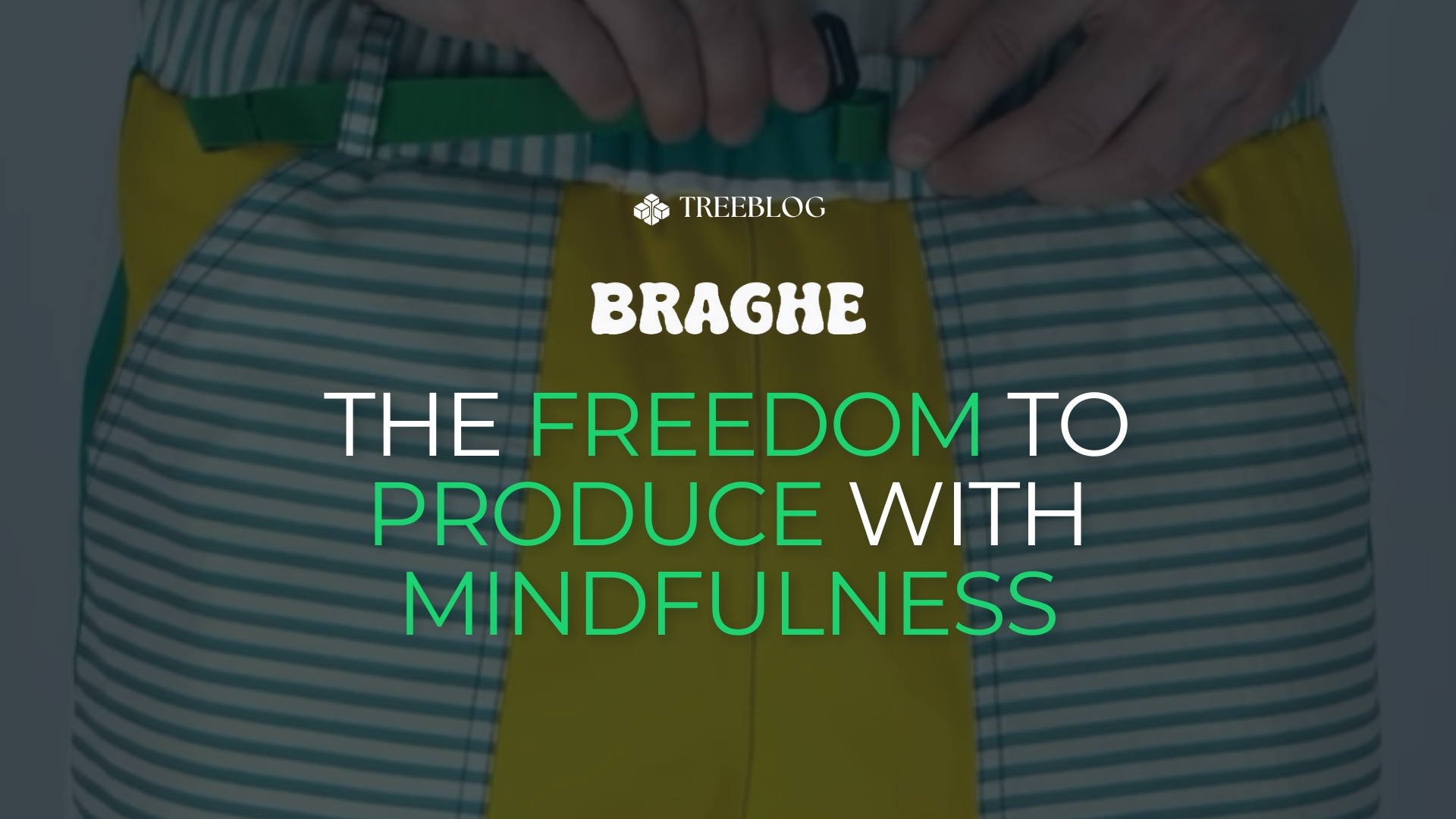
There is a place in Italy where trousers are born twice. The first time when the fabric is produced. The second when someone decides that fabric will not become waste.
Braghe is a brand founded in Noventa Vicentina that produces climbing trousers, but what it really represents is something broader: that responsible production is possible, that recycling is not a fallback solution, and that sustainability is not a passing trend but an inevitable direction.
It does so through second-life fabrics, an extremely short supply chain, handmade one-of-a-kind pieces, and a clearly defined community of climbers, people used to trusting only what truly holds.
Each pair of trousers is unique. Like a work of art
What stands out first about Braghe is the natural way uniqueness becomes the norm. No two trousers are the same because no two materials are identical. Each piece comes from reclaimed fabrics that constantly change, making standardisation impossible.
Every pair is named after a climbing route, because just like a route, it cannot be replicated. Each garment carries its own story, its own material and its own journey.
This approach, which the founders themselves describe with a touch of irony as a kind of artisanal obsession, is the exact opposite of fast fashion logic. No continuous production, no warehouses to fill, no need to manage unsold stock.
Only garments produced when it makes sense to produce them, and within the time needed to do it properly.
It is a slower model, more complex and less easily scalable. And that is exactly what makes it credible.
A supply chain you could almost walk through
One of the most concrete aspects of the project is its supply chain.
Production happens within the same territory, with suppliers, tailors and collaborators working within close proximity. Reducing distances certainly reduces transport and emissions, but it also means maintaining a direct relationship with the people who actually make the product.
In Braghe’s case, a short supply chain is not just an organisational choice. It is a form of responsibility. It means knowing who sews, who cuts, who works the materials. It means working with professionals coming from the high-fashion sector who bring real expertise into an independent project.
In an industry where it is often difficult to trace the true origin of a garment and the conditions under which it was produced, this choice has something surprisingly simple about it: producing locally to remain aware of what you are creating.
Producing only what makes sense to produce
Braghe does not work with seasonal collections. It works with drops, small product releases created only when materials and timing genuinely allow it. This is not a marketing tactic to create anticipation, but a natural consequence: when every piece is unique and fabrics change constantly, continuous production simply cannot exist.
This logic leads to a consequence that is both simple and rare: only what can be produced well is produced. In a market built on excess, where overproduction generates waste and waste inevitably generates emissions, choosing to slow down already becomes a form of positioning.
Fabrics come from fashion supply chain deadstock: unused rolls stored in service warehouses, materials rejected for minor defects, leftovers from productions that no longer have a destination. Where others see a logistical problem, Braghe sees raw material.
Even the smallest fabric scraps, those that would normally be discarded, find a purpose. They become packaging, patches, and useful elements that help extend the life of the product. Patches are not a detail. They are a statement of intent. They communicate that a sustainable garment is not simply one that is well produced, but one designed to last. This is why repair is not an additional service but part of the project from the very beginning.
From this perspective, sustainability stops being just a purchasing choice and becomes a matter of durability. Of how long value can be preserved in what already exists.
A goal looking toward 2030
Within this vision there is also a clear direction: recovering 30,000 metres of fabric by 2030.
This is not presented as a marketing number, but as a symbolic threshold that helps connect vision and practicality. A way to measure something that would otherwise remain just an intention.
The idea is not simply to produce trousers. It is to demonstrate, over time, that what already exists can continue to have value and that every metre recovered is a small gesture against the culture of waste.
Social sustainability: when value goes beyond materials
If the environmental dimension is immediately visible, the social dimension emerges more quietly, almost naturally.
Alongside textile recovery, Braghe has started building relationships with organisations working in social inclusion, including collaborations involving incarcerated individuals in the production and printing of certain garments. These are not isolated initiatives or parallel projects, but a natural extension of the same approach guiding the entire project.
The logic remains the same, only the context changes. If for materials it means recovering what others discard, on a human level it means creating opportunities where barriers often exist.
This is also reflected in collaborations with organisations working with vulnerable people and in campaigns where people with disabilities are naturally represented, without constructing artificial narratives.
It is precisely this concreteness that makes the social dimension credible. Not the declaration of values, but the attempt to translate them into relationships, collaborations and everyday decisions that connect environment, people and territory.
Against fast fashion, quietly
Braghe does not build its identity by opposing someone. It does not use provocative tones and does not need to position itself explicitly against fast fashion. Yet every decision clearly indicates a different direction.
Today there are already enough garments to clothe future generations. In this context, continuing to produce without questioning the meaning of quantity becomes difficult to justify.
Their response does not come through ideological statements but through operational decisions: using what already exists, avoiding unnecessary accumulation, producing only when needed, accepting longer timelines if this means maintaining quality and coherence.
Pricing follows the same logic. A product has a real cost because behind it there are materials, time and skills.
“If the price seems too low, it often means someone else is paying the difference.”
It is a sentence worth reading twice.
Sustainability as a consequence, not a strategy
What makes Braghe interesting is not only the product, but the consistency between what the brand creates and the environment it comes from. Climbing, outdoor life, a direct relationship with nature, a strong sense of community. Sustainability does not appear as a strategic choice but almost as an inevitable consequence.
When the way you live and the way you produce begin to align, many decisions stop being complex and simply become logical.
Perhaps this is the most interesting aspect of the project: not the search for perfection, but the choice to remain coherent even when it would be easier to do otherwise.
And this is also what organisations like Braghe, just as TreeBlock in its own field, demonstrate every day: sustainability stops being a declaration when it enters processes, decisions and the way value is built over time.
In the end, more than a matter of communication, it is a matter of meaning. And the projects that start from here are often the ones built to last.