
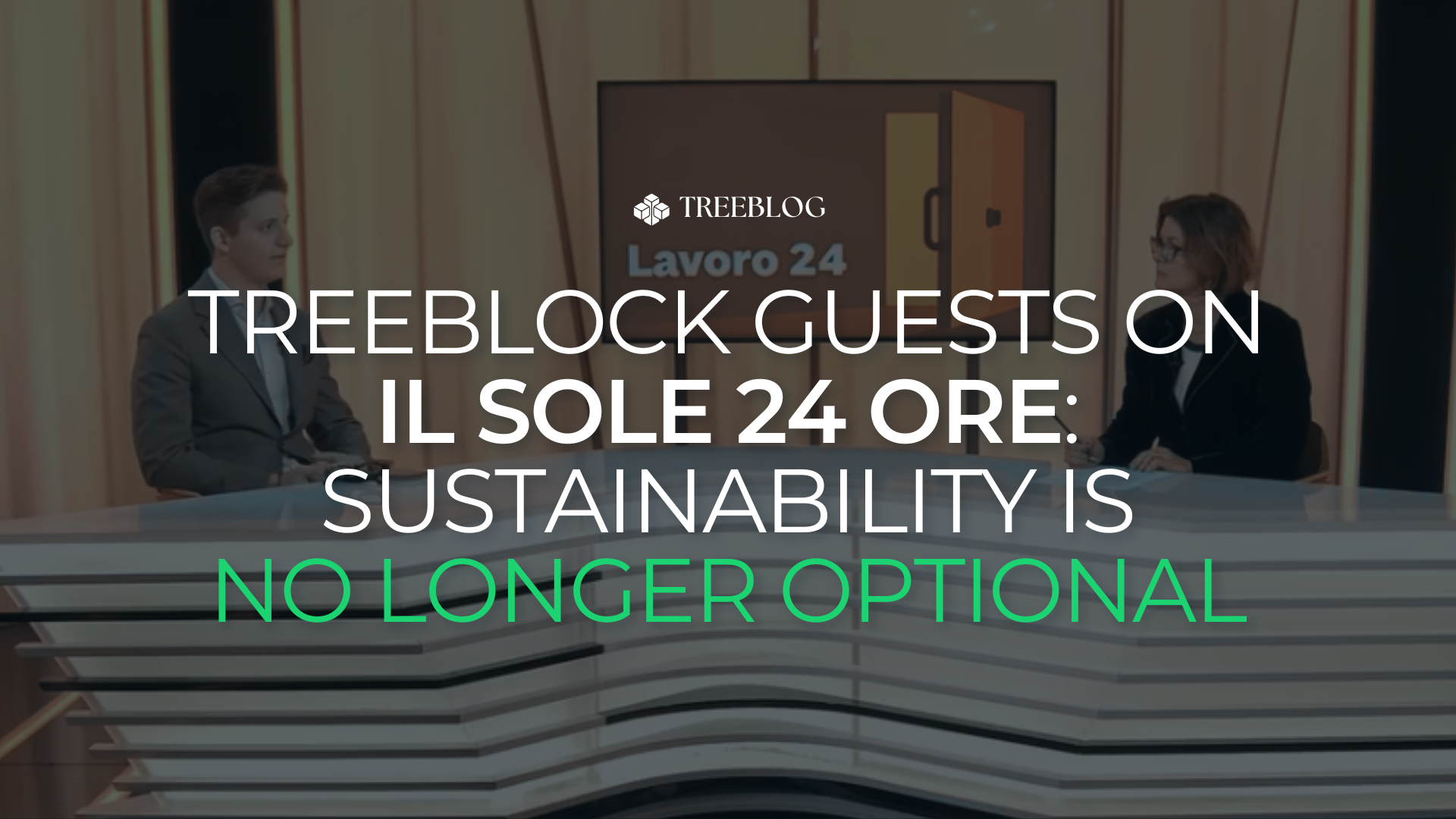
‘TreeBlock is a flywheel. A concrete bridge between two worlds that seem opposed but need to learn to talk to each other: on one side, increasingly stringent ESG regulations, on the other, the need for companies to stay competitive and do business profitably.’
Starting from this idea, Stefan Grbović, CEO and co-founder of TreeBlock, appeared on Lavoro24, IL SOLE 24 ORE’s format dedicated to the world of work and professional skills, to explain how the market is changing and why ESG competencies have become anything but optional.
Sustainability is data
One of the clearest points in the interview is about what sustainability really means when you practice it every day. It is not just a matter of values or communication: it is a matter of data, information flows to collect, process, and report according to precise standards. And doing it well requires a skill set that is not vertical on a single discipline, but horizontal across multiple fields: regulatory, environmental, managerial, and technological. The pieces fit together, and removing even one compromises the entire structure.
The interview makes clear that this complexity has made the Sustainability Manager an increasingly central figure in organizations. In 90% of cases, Grbović suggests, this is not a role built from scratch: it evolves from profiles already present within the company, such as the quality manager, the Energy Manager, the environmental engineer, or someone working in human resources. What changes is the ability to act as a connector between different departments, intercept external pressures, and translate them into a tailored strategy. In a supply chain that is constantly changing, a fixed and rigid data entry approach is not enough. What is needed is an adaptable figure, not an executor.
The most exposed sectors? Grbović names a few clearly: large-scale retail, heavy industry, automotive. Industries already feeling pressure across their entire supply chain today. University education remains the foundation, but what truly makes the difference is hands-on experience. This is precisely why TreeBlock, working closely with hundreds of companies, has developed tools that do not replicate abstract models but respond to concrete and specific needs. Every company is different, and sustainability cannot be applied with a one-size-fits-all template.
The Microsoft Office of sustainability
Not all SMEs can afford to hire two or three people dedicated exclusively to ESG reporting. TreeBlock, as Grbović points out, was built precisely to address this problem. The platform works on a modular subscription system that allows companies to choose the tools they need, automating data entry, the most tedious part of the process, and guiding the company toward reports that comply with the standards required by major clients and credit institutions.
TreeBlock’s digitalization is not generic: it is designed and built specifically for this sector, and it is the concrete expression of what is now called ESGTech, the intersection of technology and sustainability that is redefining how companies manage their reporting. From March 18, 2026, with the entry into force of the Omnibus I Directive, SMEs are formally exempt from the obligation to report ESG data, but large companies continue to request data from their suppliers, and banks have already integrated ESG criteria into credit ratings.
According to TreeBlock’s estimates, between 60,000 and 80,000 Italian small and medium-sized enterprises find themselves today in a grey area: exempt from the regulation, but not from market pressure. Those who show up without structured data find out the hard way: a supplier dropped from the list, a worsened credit offer, an opportunity that does not come back. It is worth remembering: technology in this context does not replace people, it empowers them. A Sustainability Manager working with adequate digital tools does better work, faster and more credibly.
Sustainability as resilience
There is a concept Grbović expresses clearly, and it breaks a stubborn misconception: the economic health of a company is itself an element of sustainability. You cannot do good for the environment without also doing good for the business. The return on investment exists, and the word he chooses to bring it all together is one: resilience. Not a cost to bear, not an obligation to fulfill. A condition for staying competitive in a rapidly changing market.